Your T2 filing deadline and your payment deadline are different dates

A corporation gets six months to file its T2 and two months to pay what it owes. Almost every owner remembers the first number and forgets the second, and CRA charges interest for the four months in between — on a return that is not even late yet.
Filing: six months after your tax year-end. Payment: two months after your tax year-end. Those are two different dates and they are four months apart. A March 31 year-end means the balance is due May 31 and the return is due September 30.
Some Canadian-controlled private corporations get three months instead of two to pay — but only if all three conditions below are met, not just the first one. Interest at the prescribed rate (currently 7%, reset quarterly) starts running on your balance-due day whether or not you have filed.
Two deadlines, one tax year
CRA sets your corporation's deadlines from your fiscal year-end, not from a fixed calendar date. That is the first thing that trips people up: there is no national "corporate tax day." If your year-end moves, both deadlines move with it.
| What is due | When | What late costs |
|---|---|---|
| Balance of tax owing | Two months after year-end (three in the specific case below) | Interest at the prescribed rate from the balance-due day |
| The T2 return itself | Six months after year-end | Late-filing penalty of 5% of the tax unpaid at the filing deadline, plus 1% of that unpaid tax per full month, to a maximum of 12 months |
Source for the corporate late-filing penalty: CRA, T4012 T2 Corporation — Income Tax Guide, "Before you start", CRA page updated 2026-05-28. This is the corporate rule; CRA states the penalty for individuals on a separate page, and the two should not be read across.
Read that table once more and the trap is obvious. You can be fully compliant on filing and still owe interest, because the money was due four months before the paperwork was.
The three-month exception, spelled out properly
Most pages summarise this as "CCPCs claiming the small business deduction get three months." That is wrong, and it is the kind of wrong that costs money, because a corporation that assumes it qualifies pays a month late.
CRA's balance-due day rules for corporations set out three conditions, and all three have to hold:
- The corporation was a Canadian-controlled private corporation throughout the tax year — not for part of it, and not "generally".
- It claimed the small business deduction in the current tax year, or claimed it in the previous tax year.
- Its taxable income for the previous tax year did not exceed its business limit for that year. If the corporation was associated with other corporations, the test is the associated group's combined taxable incomes against their combined business limits.
The third condition is about last year, not this year. A corporation that had a very good previous year can fail the test and drop back to two months to pay, even though it is still a CCPC and still claims the small business deduction. Whether your prior-year taxable income cleared your business limit — and what your business limit actually is after any association — is a question for your accountant, not something to assume from a blog post.
If you are not certain all three conditions hold, plan on two months. Being early with a payment costs you nothing; being a month late costs you interest from the earlier date, retroactively.
A worked example, with dates you can check
Take a corporation with a March 31, 2026 year-end that owes $15,000 in tax for the year.
| Deadline | Date |
|---|---|
| Balance due — standard two months | May 31, 2026 |
| Balance due — if all three exception conditions hold | June 30, 2026 |
| T2 return due — six months | September 30, 2026 |
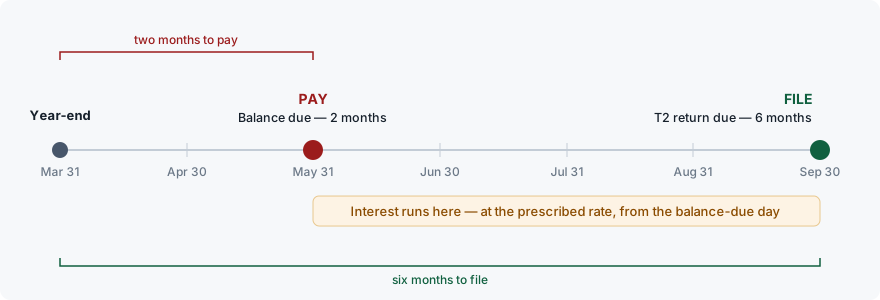
Say this corporation does what most do: the accountant finishes the return in September, the owner pays the balance when the return is filed on September 30, and everyone considers the year closed. The return was filed on time, so there is no late-filing penalty. But the $15,000 was due on May 31.
Four months of interest at the current prescribed rate of 7% on $15,000 works out to roughly $350. Nothing was late in the sense the owner was thinking about. The money was simply paid four months after CRA's clock started.
Source: CRA, Balance-due day, CRA page updated 2026-01-21, and 2026 tax deadlines for Canadian businesses and self-employed individuals, CRA page updated 2026-05-15.
How the interest works, and why it is not a penalty
Interest and penalties are separate machines and they run on separate triggers. The late-filing penalty is triggered by the return arriving after the six-month deadline. Interest is triggered by the balance sitting unpaid after the balance-due day. You can trip one without the other, and plenty of well-run corporations trip the interest one every single year without realising it.
The rate is set quarterly. For Q3 and Q4 of 2026 the prescribed rate on overdue taxes is 7%. It has been higher and it has been lower, and it will change again, which is why the number to bookmark is CRA's prescribed interest rates index rather than any single quarter's page.
Two practical consequences follow. First, if you know roughly what you owe, pay an estimate by the balance-due day and true it up when the return is filed — the interest clock only runs on what is still outstanding. Second, the clock does not pause because your accountant has not finished — interest runs on the balance, not on the paperwork.
Source: CRA, Prescribed interest rates, fourth quarter 2026, CRA page updated 2026-08-28. The rate changes every quarter.
Self-employed? The split runs the other way
If you are a sole proprietor or a partner rather than a corporation, you have the same two-deadline problem in mirror image. Your return is due June 15, but any balance owing is due April 30 — so the payment deadline lands nearly seven weeks before the filing deadline.
Corporations pay first and file later; self-employed people also pay first and file later. In both cases the money is due before the paperwork. That is the single sentence worth carrying around. Every other filing date a Canadian business has to hit is collected on the full small business deadline calendar.
What a bookkeeper does with the six-month window
Six months sounds generous until you notice that nobody uses the first five. Here is what changes when the books are current instead of being assembled in month five:
- You get an early estimate of the balance owing. Books that are closed within a few weeks of year-end mean your accountant can give you a tax estimate before the two-month balance-due day, so you pay something on time instead of paying 7% for the privilege of not knowing.
- Reconciled accounts mean the year-end package is a handover, not an investigation. Every bank and credit card account tied out, the GST/HST control accounts agreeing to what was filed, and payroll matched to the remittances — that is the package described on what your accountant actually needs from you at year-end, and it is the difference between a two-week turnaround and a two-month one.
- Shareholder-loan and owner-draw activity gets cleaned up while people still remember it. Chasing an unexplained $5,000 transfer in month one takes a phone call. Chasing it in month five takes an afternoon and a guess.
- Nothing is discovered in September. The expensive year-ends are the ones where a missing quarter of records surfaces two weeks before the filing deadline, and there is no version of that story where it gets cheaper.
None of this is tax planning. Whether the three-month exception applies to your corporation, how much to leave in the company, what your business limit looks like after association — those go to an accountant. What a bookkeeper does is make sure the accountant gets numbers they can trust, early enough to be useful.
Close your year-end early enough to pay on time
We keep your books reconciled month by month and hand your accountant a clean year-end package within weeks of your fiscal year-end, so you know what you owe before the balance-due day rather than four months of interest afterwards.
If your books are a long way from ready, start with what catch-up bookkeeping costs when you are behind. If you want to know what a full late position costs across every tax type, every CRA late penalty in one table has the arithmetic.
Questions people actually ask
When is my corporate tax return due in Canada?
Your T2 corporate income tax return is due six months after the end of your corporation's tax year. If your year-end is March 31, the return is due September 30. If your year-end is December 31, it is due June 30. The deadline moves with your fiscal year-end, so there is no single national date for corporations the way there is for personal returns.
Is the T2 payment deadline the same as the filing deadline?
No, and this is the most expensive mix-up in Canadian small business tax. The balance of tax owing is due two months after your year-end, while the return itself is not due until six months after year-end. That leaves a four-month gap where CRA charges interest on an unpaid balance even though your return is perfectly on time. Pay an estimate by the two-month date and true it up when the return is filed.
Which corporations get three months to pay instead of two?
Only those meeting all three of CRA's conditions. The corporation must have been a Canadian-controlled private corporation throughout the tax year; it must have claimed the small business deduction in the current or the previous tax year; and its taxable income for the previous tax year must not have exceeded its business limit, or, if it is associated with other corporations, the group's combined taxable incomes must not have exceeded their combined business limits. Missing any one of the three puts you back on the two-month clock. Whether your corporation qualifies is a question for your accountant.
What does CRA charge if I pay my corporate tax late?
Interest at the prescribed rate, running from your balance-due day until the balance is paid. For the third and fourth quarters of 2026 that rate is 7% on overdue taxes. The rate is reset every quarter, so check CRA's prescribed interest rates index rather than relying on a figure you saw last year. Interest is separate from the late-filing penalty, which only applies if the return itself arrives after the six-month deadline.
What is the late-filing penalty on a T2?
CRA's T2 guide puts it as 5% of the unpaid tax that is due on the filing deadline, plus 1% of that unpaid tax for each complete month the return is late, to a maximum of twelve months. A higher repeat rate of 10% plus 2% a month, to a maximum of twenty months, exists — but it only applies where CRA both served you a demand to file and assessed a failure-to-file penalty in any of the three previous tax years. Both of those conditions have to be true, not just one.
When do self-employed people have to file and pay?
If you are self-employed, or your spouse or common-law partner is, your personal return is due June 15, but any balance owing is due April 30. The payment deadline comes first, which catches people out every year. Quarterly instalments, where you are required to make them, fall on March 15, June 15, September 15 and December 15.