When your payroll remittance is due, and what late costs

You are probably reading this because a date is close. So the table is first, the explanation is second, and the part where three days late costs 3% is right after that.
Your due date depends on your remitter type, and your remitter type depends on your average monthly withholding amount (AMWA). Most small employers are regular remitters — AMWA under $25,000 — and a regular remitter's deductions are due by the 15th of the month following the month the employees were paid.
If you withhold more than that, you are an accelerated remitter and you pay more often. If you withhold much less and have a clean compliance history, you may be a quarterly remitter. Find your row in the table below.
Find your remitter type
| Remitter type | Average monthly withholding amount | When your remittance is due |
|---|---|---|
| Quarterly — new small employer | Under $1,000 a month, with conditions | April 15, July 15, October 15 and January 15 |
| Quarterly — small employer | Under $3,000, with a perfect compliance history | The same quarterly dates |
| Regular | Under $25,000 | The 15th of the month following the month you paid your employees |
| Accelerated, threshold 1 | $25,000 to $99,999.99 | Paid in the 1st to 15th of a month, due the 25th of that same month. Paid in the 16th to the end of a month, due the 10th of the next month. |
| Accelerated, threshold 2 | $100,000 or more | The 3rd working day after the 7th, 14th, 21st and last day of the month |
What AMWA means, in plain language
AMWA stands for average monthly withholding amount, and CRA gives the calculation directly: the total of all required payroll deduction remittances in a calendar year, divided by the number of months in that year that required a remittance, to a maximum of twelve. The remittances themselves are income tax, Canada Pension Plan contributions and Employment Insurance premiums, including both the employee's share and your employer share. Your remitter type is set from your AMWA of two calendar years ago, not from what you are withholding this month.
Two things about it surprise people. It is not your payroll — a business paying out a great deal in wages can still have a modest AMWA, because it is the withholding that counts rather than the gross. And you do not pick your schedule: CRA works the AMWA out, assigns your remitter type and notifies you in writing. If you think the assignment is wrong you can ask CRA to review it, but until they do, the schedule you were given is the schedule.
Source: CRA, Remitting source deductions — how and when to remit, and due dates, CRA page updated 2026-06-11.
Quarterly status is not automatic just because you are under the dollar figure. Both quarterly tiers also require a clean compliance history — CRA's wording for the $3,000 tier is a perfect compliance history — and the under-$1,000 tier additionally requires that you are a new employer. Being under the threshold is necessary, not sufficient. If CRA has not told you that you remit quarterly, you do not remit quarterly, and assuming otherwise means missing eleven due dates a year.
When the due date lands on a weekend or a holiday
Your remittance is considered on time if CRA receives it — or a Canadian financial institution processes it — on or before the next business day. So a 15th that falls on a Saturday effectively becomes the following Monday.
The useful thing to notice in that rule is the phrase "received or processed." It is not about when you clicked send. If you pay through your bank, build in the time your bank actually takes, because a payment that leaves your account on the due date and reaches CRA two days later is late by CRA's clock.
Source: CRA, Remitting source deductions — how and when to remit, and due dates — CRA page updated 2026-06-11.
What being late costs
This is the part worth internalising, because the penalty starts immediately and it is charged on the amount you owe, not on how late you are in any proportional sense.
| How late | Penalty |
|---|---|
| 1 to 3 days late | 3% |
| 4 or 5 days late | 5% |
| 6 or 7 days late | 7% |
| More than 7 days late, or not remitted at all | 10% |
| A second or subsequent assessment in the same calendar year, where the failure was knowing or grossly negligent | 20% |
Three days late costs 3%. Say that out loud with a number attached: on a $5,000 remittance, being three days late is $150 gone. Not $150 of interest accruing over a year — $150, on the third day. Miss it by more than a week and the penalty is 10%, so the same remittance costs $500.
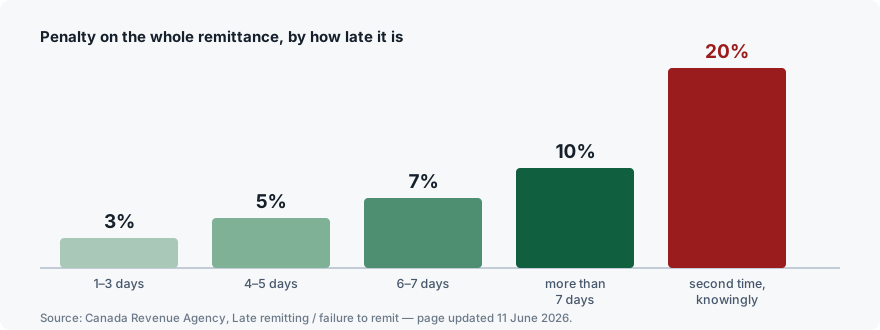
There is no annualising or prorating here. A 3% penalty for a three-day delay, expressed as an annual rate, is an extraordinary number, which is exactly why remittance dates are the deadlines to automate first.
On top of the penalty, CRA charges prescribed interest on overdue amounts, including source deductions. For the third and fourth quarters of 2026 that rate is 7%. The prescribed rate is reset every quarter, so check the current one rather than assuming this figure holds.
Sources: CRA, Late remitting or failure to remit — CRA page updated 2026-06-11; CRA, Prescribed interest rates, Q3 and Q4 2026.
The payroll penalties above are one of several separate CRA penalty regimes a small business can trigger. Every CRA late penalty in one table puts income tax, GST/HST, payroll and information returns side by side, because CRA's own site splits them across four different sections.
The 2026 numbers you are withholding against
Your remittance is the sum of income tax withheld, CPP and CPP2 contributions, and EI premiums, plus your employer share. These are the 2026 maximums and rates, for reference when you are checking whether a pay run looks right.
| Item | 2026 figure |
|---|---|
| CPP — maximum pensionable earnings (YMPE) | $74,600 |
| CPP — basic exemption | $3,500 |
| CPP — employee and employer rate | 5.95% |
| CPP — maximum employee contribution | $4,230.45 |
| CPP — maximum employer contribution | $4,230.45 |
| CPP — maximum self-employed contribution | $8,460.90 |
| CPP2 — additional maximum earnings (YAMPE) | $85,000 |
| CPP2 — rate | 4.00% |
| CPP2 — maximum employee contribution | $416.00 |
| CPP2 — maximum employer contribution | $416.00 |
| EI — maximum insurable earnings | $68,900 |
| EI — employee rate outside Quebec | 1.63% |
| EI — maximum employee premium outside Quebec | $1,123.07 |
| EI — maximum employer premium outside Quebec | $1,572.30 |
| EI — employee rate in Quebec | 1.30% |
| EI — maximum employee premium in Quebec | $895.70 |
| EI — maximum employer premium in Quebec | $1,253.98 |
The employer's EI premium is 1.4 times the employee's, which is why the employer maximum is higher than the employee maximum. CPP and CPP2 are matched dollar for dollar between employee and employer.
These change every year, usually announced in the autumn for the following January. If you are reading this in a later year, pull the current figures from the CRA index pages rather than trusting a number in an article. And note what is not here: Quebec Pension Plan rates come from Revenu Québec rather than CRA, so this page does not publish them. The Quebec EI figures above are CRA figures and are safe to use.
Sources: CRA, CPP contribution rates, maximums and exemptions and second additional CPP contribution rates and maximums, both updated 2025-10-31; CRA, EI premium rates and maximums, updated 2025-09-16.
The other payroll deadline: T4s
Remittances are monthly or more often. Once a year there is a second deadline that has nothing to do with your remitter type: T4 slips and the T4 Summary are due the last day of February for the preceding calendar year. Your employees need their slips by then too.
Late T4s carry their own penalty scale, separate from the remitting penalties above, with a minimum of $100. Filing more than five information returns for a calendar year means filing electronically to avoid a further penalty, in CRA's own wording.
How to stop this from being a monthly worry
Three habits remove almost all of the risk here. Confirm your remitter type in writing rather than assuming it. Put the dates in a calendar as recurring entries, with a reminder several days early so a bank's processing time cannot make you late. And reconcile what you actually remitted against your payroll journal every month, so a shortfall surfaces the same month instead of at year-end when the penalty has already been assessed. The monthly bookkeeping checklist built around CRA's calendar sets that routine out in order.
Never be three days late again
We track your remitter type and your due dates, post the payroll entries, and reconcile what left your bank against what CRA received — so a 3% penalty on money you already had set aside stops being a thing that can happen to you.
Questions people actually ask
When is my payroll remittance due?
It depends on your remitter type. Most small employers are regular remitters, with an average monthly withholding amount under $25,000, and their deductions are due by the 15th of the month following the month employees were paid. Accelerated remitters with an AMWA of $25,000 to $99,999.99 pay twice a month, and those at $100,000 or more pay on the 3rd working day after the 7th, 14th, 21st and last day of the month. Quarterly remitters pay on April 15, July 15, October 15 and January 15.
What is the average monthly withholding amount?
CRA calculates it as the total of all required payroll deduction remittances in a calendar year, divided by the number of months in that year that required a remittance, up to a maximum of twelve. Those remittances are income tax, Canada Pension Plan contributions and Employment Insurance premiums, including both the employee's share and the employer's share. CRA uses your AMWA from two calendar years ago to assign your remitter type and notifies you in writing. Two things to note: it is based on withholding rather than on gross payroll, and you do not choose the schedule — though you can ask CRA to review the assignment if you think it is wrong.
Can I remit payroll deductions quarterly?
Only if CRA has told you that you can. There are two quarterly tiers and neither is automatic at the dollar threshold. The small employer tier requires an average monthly withholding amount under $3,000 and a perfect compliance history. The new small employer tier requires an AMWA under $1,000, plus conditions, and being a new employer. If CRA has not confirmed quarterly status, remit on your assigned schedule — assuming quarterly when you are a regular remitter means missing eleven due dates a year.
What is the penalty for remitting payroll deductions late?
CRA charges 3% if you are one to three days late, 5% at four or five days, 7% at six or seven days, and 10% once you are more than seven days late or have not remitted at all. A second or subsequent assessment in the same calendar year, where the failure was knowing or grossly negligent, is charged at 20%. Prescribed interest applies on top — 7% for the third and fourth quarters of 2026. On a $5,000 remittance, three days late is $150.
What happens if my remittance due date falls on a weekend?
Your remittance is on time if it is received by CRA, or processed at a Canadian financial institution, on or before the next business day. So a due date landing on a Saturday effectively moves to the Monday. The wording matters more than it looks: the test is when the payment is received or processed, not when you submitted it. If you pay through your bank, allow for the days your bank takes, because a payment that leaves your account on the due date can still arrive late.
When are T4 slips due?
T4 slips and the T4 Summary are due the last day of February for the preceding calendar year, and your employees need their copies by then as well. That deadline is fixed and has nothing to do with your remitter type. Late filing carries its own penalty scale, separate from the late-remitting penalties, with a minimum of $100. If you file more than five information returns for a calendar year, CRA requires electronic filing to avoid a further penalty.